
Predictions about the future are hard.
The Liberal Party might not quite be doomed...but 'business as usual' is not an option.

After my Australian Financial Review column appeared on the weekend, I got a text from a friend saying he'd read it, found it interesting, but I was being melodramatic. He said the condition of the Liberal Party wasn't as bad as I'd made out. This is what I wrote - you can judge for yourself whether my friend was right.
Coalition MPs now have plenty of spare time on their hands. They could do worse than read the business school classic, Jim Collins' Good to Great: Why Some Companies Make the Leap … and Others Don't.
Those MPs could read the story of the Great Atlantic and Pacific Tea Company. The A&P was once the largest retail company in the world. In the 1930s it had more than 15,000 stores. Collins asks, "how could a company as great as A&P become so awful?" A&P prospered until the 1950s, but then affluence changed America. While the company offered cheap food in utilitarian stores, shoppers demanded "fresh-baked bread, flowers, health foods, cold medicines, fresh produce, forty-five choices of cereal and ten types of milk".
Struggling to respond, "A&P then began a pattern of lurching from one strategy to another, always looking for a single-stroke solution to its problems. It held pep rallies, launched programs, grabbed fads, fired CEOs, hired CEOs, and fired them yet again." That sounds familiar.
One week, the Liberal Party is moving to "the right"; the next week, it is shifting to "the centre" (i.e. the left), then back again. In 10 years it has cycled through five leaders. The Liberals' policies change as often as its leadership. During the election campaign, the Liberals thought it was more convenient to either not have policies or release them two days before polling day.
Good to Great was published in 2001. When Coalition MPs go on to Wikipedia to find out what became of A&P they'll discover it went bankrupt in 2015. Its head office was bulldozed to build apartments.
I was making the point that nothing is ever guaranteed. The Western Australian MP, Andrew Hastie said something similar last week on the Four Corners program about the Coalition's election debacle.
There's no reason to think that we won't disappear over time if we don't get our act together. That's how serious this challenge is for the Liberal Party.
According to a former colleague of mine, Ken Phillips it's already all over for the Liberals. Ken wrote on his Substack yesterday (you can subscribe to it here - it's excellent) - 'Death of the Liberal Party. Why the Australian Liberal Party is in terminal decline. It's over!'
I might not go that far - yet… But the Liberal Party is facing existential-like challenges. I'm not sure the best way to face those challenges is by agreeing to Labor's plans for higher taxes. It looks like the Liberal Party's first major policy decision after the federal election will be to support Labor's increased taxes on superannuation (if Labor agrees to index the amounts and get rid of its plans to tax unrealised gains). From media reports it appears as if the Liberals are eager to cooperate with Labor so that the new shadow cabinet doesn't come across as a 'obstructionist'. In 2016 it was the Liberals with Scott Morrison as treasurer under Malcolm Turnbull who launched the first major tax raid on superannuation…and the tradition continues. Back then Morrison defended the Liberals' higher taxes because they 'will only affect four per cent of Australians'. This is exactly what Labor is saying now - 'only 80,000 people' will be affected by the changes. The Liberals haven't yet learned to just say 'No!' to higher taxes. For the Liberals it really is business as usual - which is what I said in my column.
[After the election] many Coalition MPs acted as if it was business as usual. The Liberals and Nationals made their priority the signing of a new Coalition deal – that is, to carry on after the election just as they had before. This panicked knee-jerk reaction from both parties to immediately revert to doing what they'd always done doesn't inspire confidence that Liberal and National MPs want to do the hard thinking and have the arguments that are so obviously necessary if the Coalition's course is to be changed.
Neither leader said, "no one is signing anything until we work out what just happened and what we think it means". The Coalition is looking at six years in opposition. There was no hurry to do anything.
The only things to show from a decade of Coalition' unity' are two terms of lacklustre government and one term of mediocre opposition.
It's moot now because the Coalition deal has been done and the combined Liberal/National shadow ministry announced. The two parties apart (at least for a while) would have strengthened the opposition to the Albanese government - not weakened it. There should be as many voices in opposition to the ALP as possible: the Liberals, the Nationals, One Nation, and so on - even the Greens. (Remember, only the Greens opposed Labor's social media ban for under-16-year-olds. And of course it was the Nationals who in November 2022 announced their decision to oppose the Voice, more than five months before the Liberals eventually took a position.)
Those who don't take as bleak a view of the Liberals' future as Ken Phillips would claim, 'But the Liberal Party has been here before. Predictions of its demise have been proved wrong and will be proved wrong again.' That's indeed true - and as it happens in a speech I gave at The Sydney Institute on Wednesday night last week, I discussed one of the most famous predictions in recent Australian political history.
The great Gerard Henderson, the Executive Director of the Sydney Institute is from Melbourne. He loves his AFL, and I couldn't resist referring to his beloved Essendon Football Club, which, just like the Liberal Party, had once experienced success but now had fallen on hard times and was accused by its critics of 'lacking an identity'. (Essendon hasn't won a final in twenty years.)
Gerard regularly warns political pundits that' predictions are hard, particularly about the future'. More than once he's referred to one of the most particularly (in)famous examples. Back in July 1993, the Liberal Party hadn't just lost two elections in a row; it had lost four consecutive elections. In an article in The Age titled, 'The Party on the road to nowhere', left-wing university academic Judith Brett wrote:
The Liberal Party in the 1990s seems doomed.
As predictions go, that one couldn't have been more spectacularly wrong.
John Hewson, the Liberal leader in July 1993, was replaced in May 1994 by Alexander Downer, who ten months later was then replaced by John Howard. And the rest, as they say, is history. The Coalition won seven of the eleven federal elections after Brett's article.
But as wrong as Brett was, she had a point. The Liberal Party of 1993 and Fightback! and John Hewson didn't have a social conscience, didn't have a sense of community, and its values were only about money. Brett explained:
[The Liberal Party in 1993] is unable to talk coherently about any topic other than economics, and, while economics is important, there are many other issues on which a party making a claim for national government needs to have a position with which its supporters are moderately comfortable, not least because people still look to politics for the articulation of moral values as well as the delivery of material rewards.
Brett was right. What she said about the Liberals in the 1990s applies in 2025. Today many Liberals believe 'the articulation of moral values' smacks of 'the culture wars', and so economics is all that Liberals have left to talk about. And in an economics bidding war, Labor wins. At the 2025 federal election, Anthony Albanese articulated Labor's moral values brilliantly - 'A Labor government will look after you and financially support you (even if that money is borrowed from future generations).' The Liberals had no response. Peter Dutton and the Coalition avoided any discussion of moral values, whether applied to the economy, to culture or to anything else. Labor's campaign on the other hand was entirely based on moral values.
To be fair to Brett, looking at the Liberals in the 1990s under John Hewson, you can see how she could have come to her conclusion about the party's fate. Whereas Menzies' success was built on a commitment to 'modest aspiration', 'moral pride', and 'community', Hewson 'was unable to project any convincing vision of the shard values on which Australian life should be based…[and he] convincingly represented the rewards of success but offered little comfort to the slow, the ill or the down-at-heel.'
The most interesting aspect of Brett's article was her discussion of John Howard. In 1993 Howard was in the political wilderness. He was the shadow minister for industrial relations and ranked tenth in the pecking order of the Coalition shadow cabinet. Five years earlier, when he was opposition leader, the cover of The Bulletin magazine labelled him 'Mr 18 Per Cent' (he was preferred PM by 18% of voters, compared to the 69% who preferred Bob Hawke) and underneath was 'Why on earth does this man bother?' Yet Brett identified Howard as the only Liberal 'prepared to talk about social questions, to stop talking about economics and talk about values.' The problem, according to Brett, is that when Howard did talk about social questions, he was 'divisive'. For example, Howard 'introduced the term' One Australia', stressing the commitment newcomers should make to Australia's cultural and social values, as well as its laws and political institutions, [which] alienated many Australians of non-British background, as well as many of the latter who value Australia's post-war cultural diversity.'
His four election victories proved Howard's vision for Australia wasn't quite as 'divisive' as Brett believed. Or, to be more precise, Howard's vision might have been 'divisive' to left-wing academics like Brett, but not to mainstream Australians.
It's funny all of the Liberal leaders who have taken the party from opposition to government - Robert Menzies, Malcolm Fraser, John Howard, and Tony Abbott, were all demonised as 'divisive'. Maybe it was because they were unafraid to talk about values. The Coalition's opposition to the Voice was labelled 'divisive' - yet 60% of Australians voted No to being divided by race.
In July 1993 the Coalition had 65 seats out of the 147 in the House of Representatives. At the election that year its primary vote was 44%. If that was the condition of a 'doomed' party thirty years ago, one can only imagine what Brett would make of the Coalition's current condition. Today it holds 43 seats out of 150 and has a primary vote of 32%.
Some watching
Over the last few weeks I've done some talks and podcasts on the election and here's a selection of them. Here is the presentation that I mentioned that I gave last week at The Sydney. I appeared with Parnell McGuinness, and it was an excellent discussion followed by a lively question-and-answer session. (I think Gerard Henderson was a bit surprised when at the end of the Q&A session he asked Parnell and me to predict what we'd be talking about if we reassembled in three years just before the 2028 federal election. Half in jest, half seriously, I said we'd be analysing the contest between the Liberals leadership team of Andrew Hastie and Jacinta Nampijinpa Price and Labor's leadership of Jim Chalmers and whoever the ALP factions chose as his deputy.)
And it's not often I disagree with former prime minister and IPA Distinguished Fellow Tony Abbott. He thinks the Liberal Party is better in Coalition - I don't - and we talked about it on the most recent edition of the IPA's podcast 'Australia's Future with Tony Abbott'. We did agree on net zero though - and we talked about that too. As you can tell from the podcast, Tony is more optimistic about the Liberals' short-term future than I am. You can watch 'Australia's Future with Tony Abbott' here.
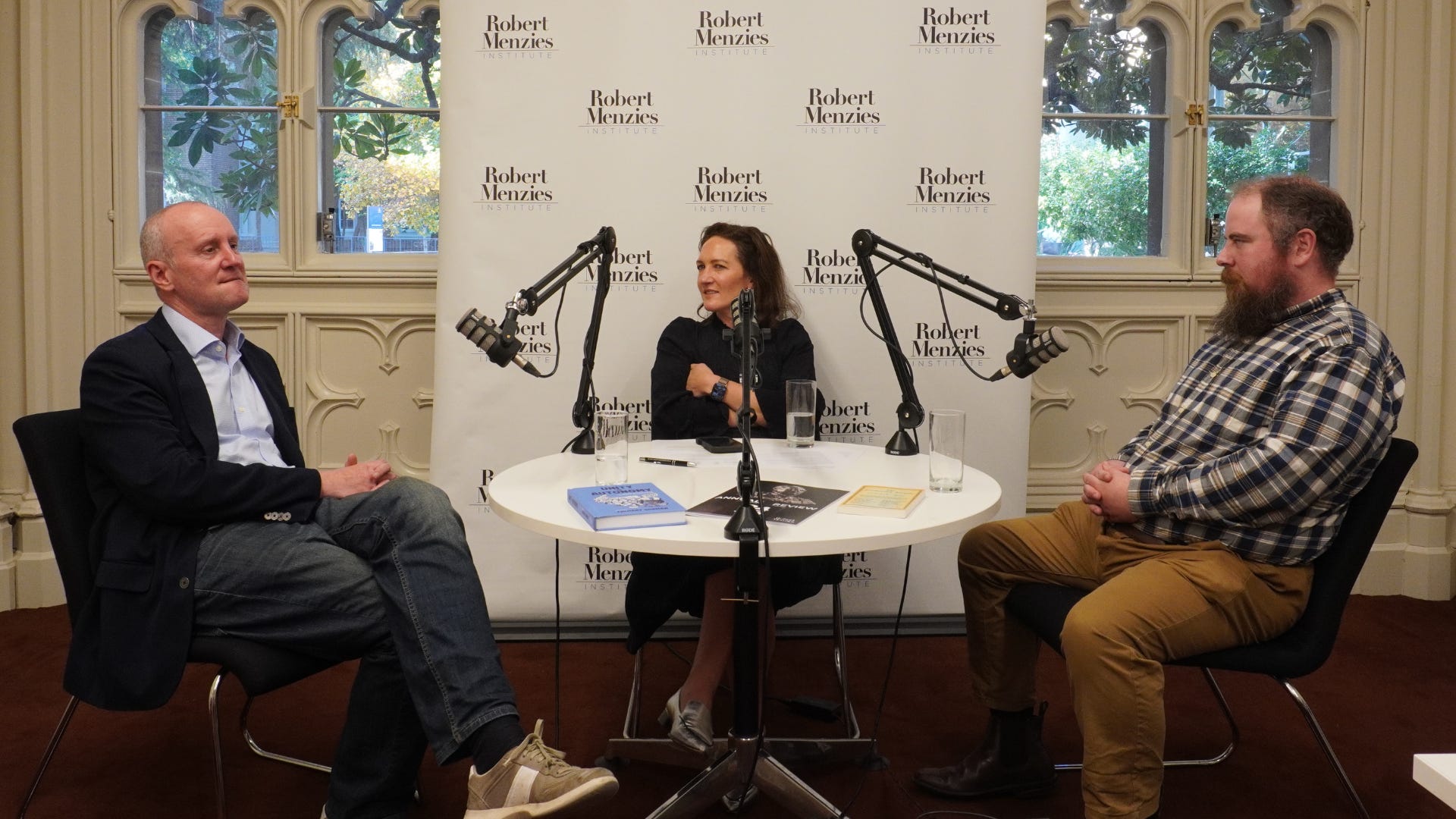
Finally, I sat down with my friends at the Robert Menzies Institute, Georgina Downer, its Executive Director and Zachary Gorman, its historian and Research Manager. You can watch it here. I really enjoyed our conversation about the campaign, what Peter Dutton did wrong (and right), and what the future holds for the Liberal Party's 'broad church'. (The podcast was filmed at the Institute's offices at the University of Melbourne - and you wouldn't believe it. Although you probably would. During the podcast there was an anti-Israel protest outside - of course there was - we were at the University of Melbourne after all. You can hear the protesters screaming in the background.)
Thank you for your support.
kind regards John
The Liberals seem to stand for nothing and fall for everything. There were so many distinctive they and the nationals could have delineate themselves on. Instead they me too'd every time they got out there. I have been voting one nation and family first and will continue to do so.
I agree with John Roskam that the better option for the immediate future would have been for the Nationals to be separate from the Liberals. As it is, the Wets in the Liberal Party will dominate the Coalition and the whole lot will continue down the gurgler.